High-Level Architecture and Components
Go from requirements to a frontend architecture: layers and their responsibilities, component hierarchy, data flow, where state lives, and how to draw and present it.
1From Requirements to Boxes
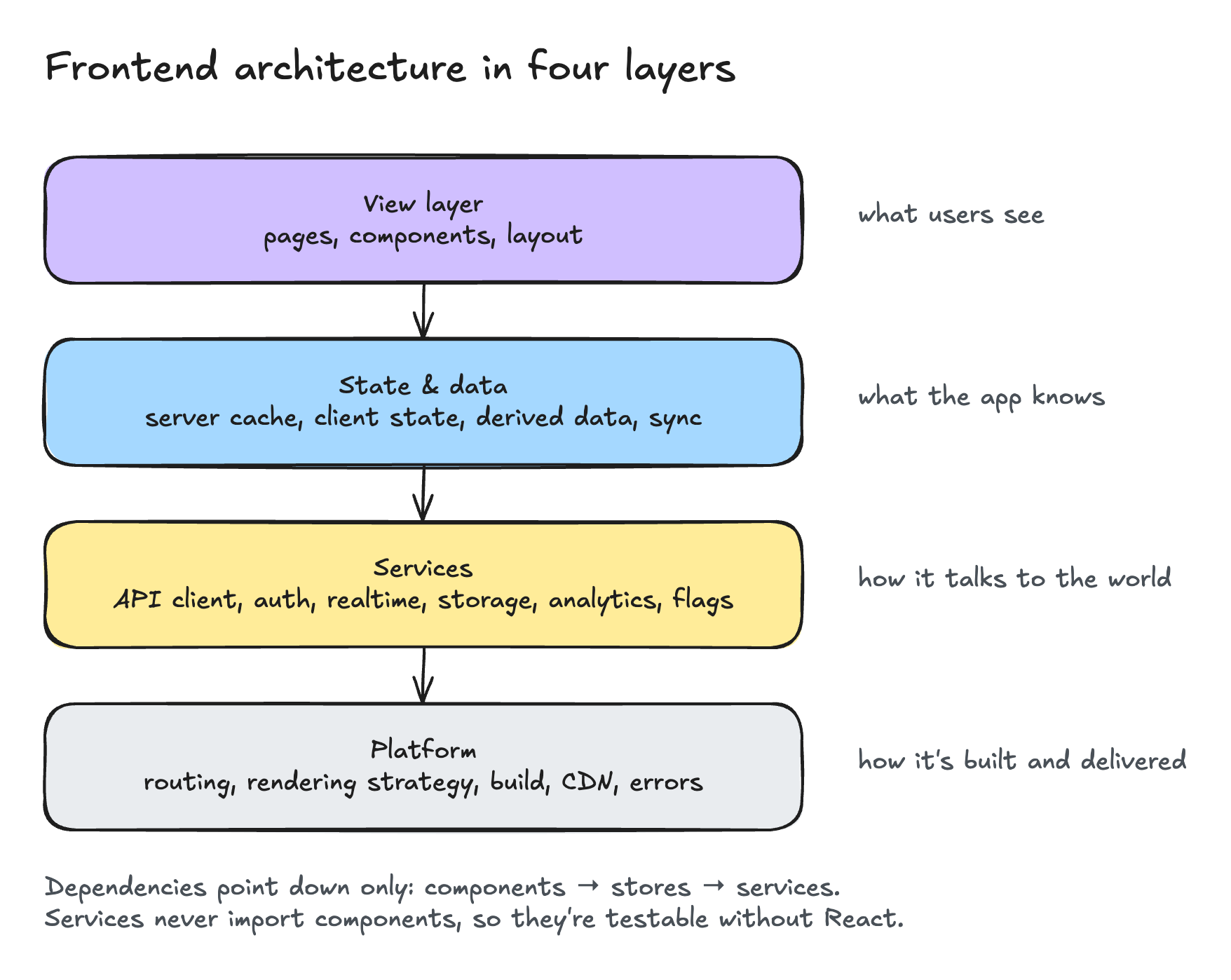
Once requirements are clear, sketch the high-level architecture: the major parts, their responsibilities, and how data flows between them. For frontend systems, a layered view like the one in the diagram works almost every time.
Dependency direction: upper layers depend on lower ones, never the reverse. Components call hooks and stores; stores call services; services know nothing about components. This keeps services testable without React, and lets you swap a view (web vs. mobile vs. embed) without touching data logic.
For each box, state in one line what it owns. If you can't, the box is either too vague or doing too much.
Key points
- 1Use layers: view, state & data, services, platform
- 2Dependencies point downward only
- 3Services stay framework-agnostic and testable
- 4Each box needs a one-line statement of ownership